





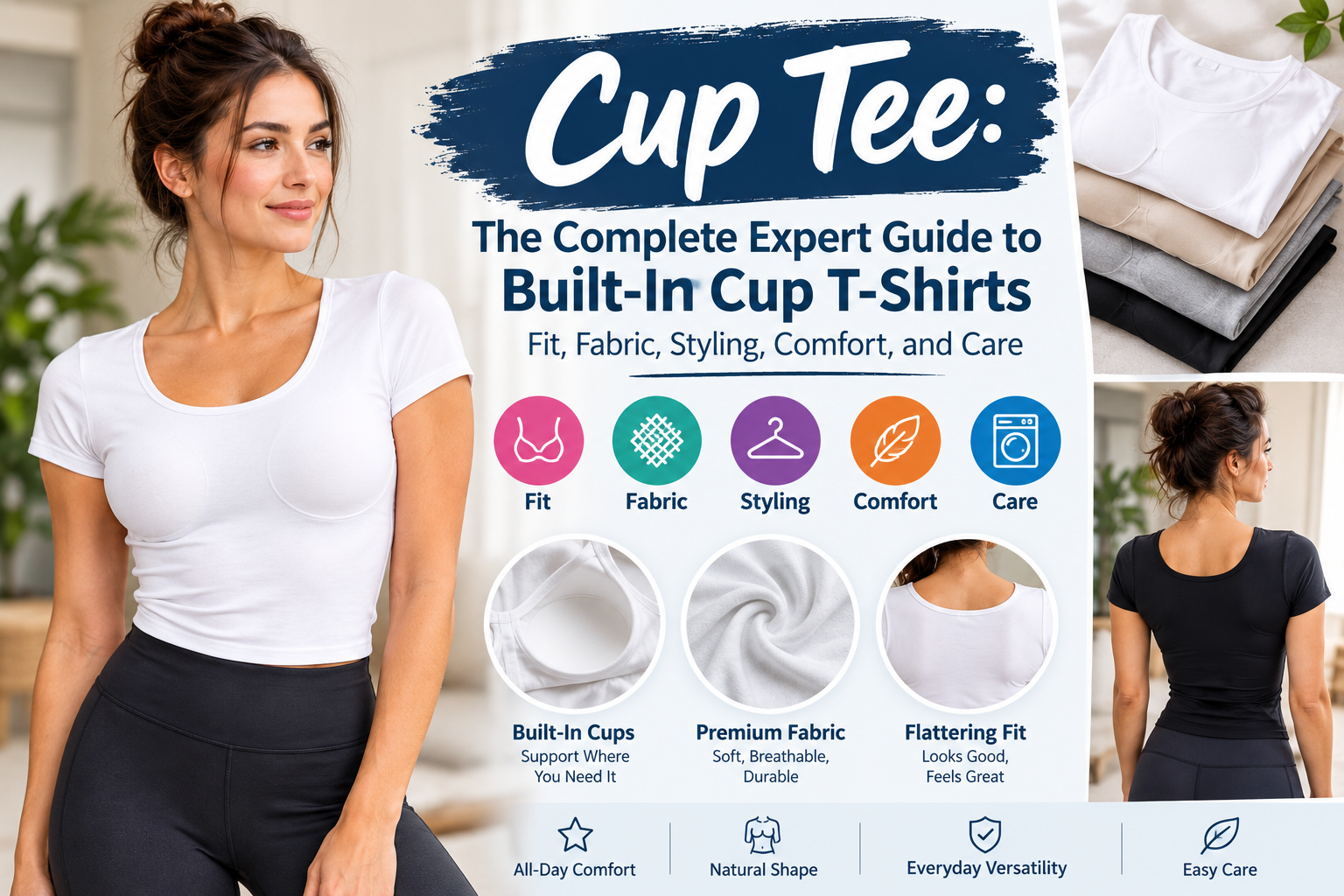
A cup tee is a type of T-shirt designed with integrated breast cups or built-in bra-style support inside the garment. Instead of requiring a separate bra underneath, the shirt combines the familiar shape and comfort of a T-shirt with an internal layer intended to provide coverage, shaping, or light support. The exact construction varies widely: some designs use removable pads, some have fixed molded cups, and others combine fabric lining with elastic support.
The phrase itself is not completely standardized across the clothing industry. Retailers may use it for a T-shirt with padded cups, a built-in wireless bra, a fitted top with internal support, or even a graphic T-shirt whose name happens to contain the word “cup.” Current retail listings illustrate this variation. For example, some garments marketed with similar terminology specifically describe integrated wireless padding, while other products use “cup” simply as part of a graphic or collection name.
That distinction matters because shoppers can easily assume that every cup-style T-shirt offers the same level of support. It does not. Construction, cup shape, fabric stretch, elastic placement, neckline, garment length, and body proportions all affect how a shirt feels and performs. Understanding those details makes it much easier to choose a garment for everyday wear, travel, lounging, casual outings, warm weather, or layering.
What Is a Cup Tee?
In practical clothing terminology, a cup tee is best understood as a T-shirt or casual top with some form of integrated breast coverage or support. The internal component can resemble the front portion of a sports bra, bralette, camisole, or lightly structured bra. Depending on the design, it may contain molded foam cups, removable pads, sewn-in padding, an elastic underbust band, or simply a double-layered chest panel.
The important feature is integration. A conventional T-shirt is essentially an outer garment, while a built-in-support shirt attempts to combine two clothing functions in one piece. This can make dressing simpler because the wearer does not necessarily need a separate bra. However, the internal construction determines whether that convenience comes with meaningful support or merely additional coverage.
A useful way to think about the concept is to compare it with a jacket that has an integrated lining. The outside may look like an ordinary jacket, but the internal layer changes how it behaves. Similarly, two T-shirts can look almost identical from the outside while feeling completely different because one has a carefully engineered support layer inside.
Modern examples range from soft everyday cotton tops to lightweight modal garments and fitted casual shirts. Some retail products specifically advertise fixed wireless padding, moderate stretch, smooth seams, and breathable materials, while others emphasize oversized silhouettes and fashion graphics instead of support.
Why Built-In Cups Have Become Popular
The appeal of integrated support is straightforward: fewer layers can mean a simpler dressing routine. A person who normally wears a T-shirt over a bra may appreciate having the support or coverage incorporated into the garment. This can be particularly useful when changing clothes quickly, traveling with limited luggage, relaxing at home, or wearing lightweight tops where visible bra lines are undesirable.
Convenience is only one part of the equation. Clothing has increasingly moved toward multifunctional designs that combine casual aesthetics with practical construction. The same trend can be seen in leggings with pockets, dresses with integrated shorts, jackets with hidden storage, and athletic tops with built-in support. The underlying idea is similar: one garment performs more than one job.
The concept also addresses a common clothing problem: layering can create heat, bulk, and visible edges. A separate bra may have straps, hooks, seams, or elastic that become noticeable beneath a thin T-shirt. An integrated design can reduce some of those visible transitions. Whether it actually does so successfully depends heavily on pattern cutting and fabric selection.
A good design therefore needs more than padding. The garment must distribute tension comfortably across the body, maintain its shape during movement, and avoid creating excessive pressure around the ribs. This is why construction quality is often more important than the simple presence of cups.
How a Cup Tee Is Constructed
The internal architecture of these garments varies considerably. At the simplest level, a shirt may have an additional fabric panel across the chest with removable foam pads inserted into small openings. This approach keeps manufacturing relatively straightforward and allows the wearer to remove the pads when desired.
Another design uses permanently sewn-in cups. These may be soft foam pieces, molded pads, or shaped fabric sections. Fixed components are convenient because they do not shift during washing or movement, but they also give the wearer less control over the silhouette. If the cup shape does not match the wearer’s body, the shirt can feel restrictive or look unnatural.
More structured garments may include an elastic band beneath the bust. This feature is particularly important because support comes not only from the cups themselves but from how the garment distributes weight and tension. A soft cup with a well-designed underbust structure can feel more secure than a heavily padded cup attached to an otherwise loose shirt.
Some contemporary products use smooth modal or similarly soft fabrics with integrated wireless padding. Retail descriptions commonly emphasize features such as lightweight construction, breathable materials, elastic silhouettes, and fixed chest pads.
Built-In Cups Versus a Traditional Bra
The biggest difference between an integrated-support T-shirt and a conventional bra is engineering precision. A traditional bra is a dedicated support garment. Its cups, straps, band, seams, and closure are specifically designed around breast support. A T-shirt with built-in cups has to balance support with the requirements of a normal shirt.
That means a built-in design may work extremely well for light support while being less appropriate for situations that require stronger stabilization. For everyday walking, casual errands, relaxing, or modest activity, many people may find integrated support sufficient. For high-impact exercise, however, a purpose-built sports bra is generally engineered more specifically for controlling movement.
Another difference is adjustability. Conventional bras commonly offer adjustable straps and multiple band or cup sizes. Many integrated tops are sold according to ordinary clothing sizes such as small, medium, large, and extra-large. This means one garment size may need to accommodate several different combinations of torso, bust, and shoulder proportions.
That limitation explains why fit should be treated as a system rather than a single measurement. A shirt can fit correctly around the waist but feel too tight at the bust. Another may fit comfortably around the chest while leaving excessive space elsewhere. The best designs balance these areas through stretch, shaping, cup placement, and pattern construction.
The Different Types of Cup Tee Designs
There is no single universal design. A soft everyday version may resemble an ordinary crew-neck T-shirt with an additional inner layer and light padding. Its primary goal is comfort and modest coverage rather than pronounced shaping.
A fitted version usually places greater emphasis on silhouette. The fabric may contain elastane or another stretch fiber, allowing the shirt to follow the body more closely. This can reduce shifting but may also increase pressure if the garment is too small.
There are also loose or oversized versions in which the outer shirt has a relaxed shape while the internal support layer remains closer to the body. This construction can create an interesting balance between fashion and function. The wearer gets the visual freedom of an oversized shirt without necessarily needing a separate underlayer.
Some products use removable pads, giving the wearer greater control. Others use fixed padding for convenience. There are also versions where the internal panel provides coverage without significant shaping. These should not be confused with highly supportive garments simply because they contain an internal chest layer.
The phrase can also appear in product names for completely different reasons. Current online retail results show examples such as coffee-themed “Cup Tee” apparel and golf-related T-shirts where “cup” refers to imagery or the sport rather than integrated breast support.
Cup Construction and Why It Matters
Cup construction influences appearance, comfort, and durability. Soft removable pads generally provide a flexible experience. They can be removed for washing, changed if damaged, or repositioned if the garment permits it. Their weakness is that poorly designed pockets may allow them to fold or move.
Molded cups create a more consistent shape. They can give the front of the garment a smoother appearance, especially beneath fitted fabrics. However, molded foam can feel warmer than a simple fabric lining, particularly in hot climates.
Sewn-in cups eliminate the nuisance of separate pads moving inside their pockets. The tradeoff is that they are harder to replace. Once the foam loses its structure or the cup shape becomes distorted, repairing the garment may be more difficult.
The thickness also matters. More padding does not automatically mean more support. Padding primarily affects coverage and shape, whereas support depends more on the garment’s overall tension, cup construction, elastic structure, and fit. This distinction is often overlooked when shoppers compare products based only on photographs.
Fabric Choices and Their Effect on Comfort
Fabric is one of the most important variables in any everyday T-shirt. Cotton remains popular because it is familiar, relatively breathable, comfortable against the skin, and easy to care for. A 100% cotton product may feel particularly pleasant for casual use, although its behavior depends heavily on weave, weight, finishing, and garment construction.
Blended fabrics can provide advantages that pure cotton does not. A small percentage of elastane can increase stretch and recovery, allowing the garment to move with the body and return to shape. Polyester can improve durability and moisture management in certain constructions, while modal and similar regenerated-cellulose fabrics are often chosen for their soft hand feel.
Fabric weight should also be considered. A very lightweight fabric may feel cooler but can reveal the outline of internal pads more easily. A heavier fabric can conceal construction better but may feel warmer.
The ideal fabric therefore depends on the use case. For a hot summer day, lightweight breathable material may be preferable. For travel or transitional weather, a medium-weight fabric can provide more versatility. For layering beneath jackets, a smooth fabric with controlled stretch can reduce bulk.
Fabric Weight, GSM, and What the Numbers Mean
GSM stands for grams per square meter and describes fabric weight. It is not a complete measure of quality, but it can help shoppers understand whether a garment is relatively light or substantial.
A lightweight shirt may be cooler and drape more easily. A heavier shirt can feel more substantial and may resist transparency better. Yet two fabrics with the same GSM can feel completely different because fiber type, knit structure, finishing, and stretch percentage influence the final hand feel.
For example, one cotton jersey can feel crisp while another feels exceptionally soft even when their weights are similar. A blended knit can also recover from stretching better than an equivalent-weight cotton fabric.
This is why fabric specifications should be read alongside fit information and care instructions. Numbers provide clues, not the entire story.
Fit: The Most Important Part of Choosing One
Fit is especially important because an integrated-support shirt must satisfy two different requirements simultaneously. The outer garment needs to look and feel like a T-shirt, while the internal layer needs to sit correctly against the body.
Start with the bust measurement rather than relying solely on your usual shirt size. Then consider the underbust area, shoulder width, torso length, and preferred amount of ease. If the manufacturer provides a garment measurement chart, compare it with a T-shirt you already own rather than guessing.
A practical approach is to measure a well-fitting shirt laid flat. Measure the chest width, length, and shoulder area, then compare those dimensions with the product’s published chart. This is often more reliable than assuming that a medium from one brand will match a medium from another.
The neckline matters too. A crew neck provides more coverage, while a scoop or V-neck can create a more open appearance. A neckline that looks attractive on a product photograph may sit differently depending on bust shape and garment stretch.
How to Recognize a Good Fit
A properly fitted garment should remain comfortable when standing, sitting, walking, and raising the arms. The internal cups should remain approximately where they are designed to sit rather than migrating upward or sideways.
Watch for pressure marks around the ribs. Mild contact is normal, but persistent digging, pinching, or discomfort indicates that the garment may be too tight or poorly proportioned.
The chest area should also appear smooth without excessive wrinkling. A little natural fabric movement is normal. Pronounced horizontal folds can indicate that the internal structure is pulling against the outer fabric.
Another useful test is movement. Lift both arms, reach forward, bend slightly, and rotate the torso. If the garment remains comfortable and the internal layer does not shift dramatically, the construction is likely working well for your body.
Common Problems and Practical Solutions
One frequent problem is cup shifting. This can happen when the internal pad is too small, the pocket is poorly designed, or the outer fabric is too loose. A removable-pad garment may solve the issue simply by repositioning the pad, while a fixed-cup design may require choosing another size or construction.
Another problem is visible pad edges. Thin outer fabric can reveal the shape of foam inserts. Choosing a thicker jersey, a textured fabric, or a better-integrated molded cup can reduce this effect.
Excessive compression is another warning sign. Some people assume tighter means more supportive, but an overly tight shirt can create discomfort without providing meaningful additional stability. Support is about controlled distribution of tension, not simply maximum pressure.
Heat can also become an issue. A multilayer garment contains more material around the chest than a conventional single-layer shirt. In warm environments, lightweight fabrics, breathable knits, and carefully ventilated designs become more valuable.
| Feature | What to Look For | Why It Matters |
|---|---|---|
| Cup type | Removable, sewn-in, or molded | Determines adjustability and shape |
| Fabric | Cotton, modal, blends, stretch jersey | Influences softness, breathability, and recovery |
| Support band | Elastic or structured underbust panel | Helps distribute tension |
| Fit | Correct bust, torso, and shoulder measurements | Reduces shifting and pressure |
| Padding | Light, medium, or molded | Primarily affects coverage and shaping |
| Seams | Smooth, flat, or reinforced | Influences comfort and visible lines |
| Care | Machine washable or delicate | Affects long-term durability |
| Garment weight | Lightweight to heavyweight | Changes warmth, drape, and opacity |
Is a Cup Tee Suitable for Everyday Wear?
For many casual situations, integrated-support T-shirts can be highly practical. They can simplify morning routines, reduce the number of clothing layers, and provide a clean silhouette under casual clothing.
They are particularly useful when the goal is convenience rather than maximum technical support. Wearing one while working from home, shopping, traveling, relaxing, or completing ordinary daily activities can make sense if the fit is comfortable.
The key is to match the garment to the activity. A casual shirt should not be expected to perform exactly like a high-support athletic garment. Clothing works best when the construction matches the demands placed upon it.
A well-designed everyday garment can become a wardrobe workhorse because it combines multiple functions without looking overly technical. That is one reason multifunctional clothing continues to appeal to consumers.
Can It Replace a Bra?
Sometimes, but not universally. Whether it can replace a separate bra depends on the wearer’s body, the garment’s construction, and the desired level of support.
A shirt with an integrated wireless cup may provide enough coverage and light support for someone who prefers a relaxed feel. Another person may require more structured support and therefore prefer a conventional bra underneath or a specialized support garment.
This is not necessarily a question of which garment is better. It is a question of purpose. A soft integrated layer can prioritize freedom and convenience, while a dedicated bra can prioritize adjustability and support.
The best approach is to judge the garment by what it actually provides rather than by the marketing phrase used on its label. Look for details about padding, band construction, cup structure, strap design, fabric stretch, and intended activity.
Wearing One for Travel
Travel is one situation where multifunctional clothing can be especially useful. Packing fewer separate garments reduces luggage volume and makes outfit planning simpler.
A shirt with integrated support can also reduce the need to carry multiple undergarment combinations. This is convenient during long flights, road trips, hotel stays, or destinations where laundry access is limited.
However, travel garments should be selected with care. Fabrics that wrinkle easily may be less convenient, while materials that dry quickly can be advantageous when washing clothes during a trip.
Durability also matters. A garment that will be washed frequently should have strong seams and fabric that maintains its shape after repeated laundering.
Wearing One During Exercise
A casual integrated-support T-shirt should not automatically be treated as activewear. Exercise creates movement forces that vary significantly depending on the activity.
Walking and gentle stretching generally impose less demand than running, jumping, or high-intensity training. A T-shirt with minimal internal support may feel perfectly comfortable during low-impact activities but insufficient during vigorous movement.
Purpose-built sports bras use specific structures to manage motion. If an activity produces substantial movement, selecting a garment designed for that activity is more sensible than assuming padding alone provides support.
For casual gym sessions, light stretching, or walking, an appropriately constructed top may be convenient. For higher-impact training, support requirements should take priority over convenience.
Styling a Cup Tee Casually
The easiest way to style one is to treat it like an ordinary T-shirt. Pairing a neutral color with jeans, relaxed trousers, shorts, or casual skirts creates an uncomplicated everyday outfit.
For a more polished look, tuck the front into high-waisted trousers and add a lightweight overshirt, blazer, cardigan, or structured jacket. The integrated inner layer can help maintain a clean base beneath the outer layer.
Oversized designs work particularly well with fitted bottoms because they create contrast between relaxed and structured proportions. A fitted top, meanwhile, can work beneath a loose jacket or open shirt.
Color also influences versatility. White, black, gray, cream, navy, and muted earth tones tend to coordinate easily with other wardrobe pieces.
Styling for Warm Weather
Warm-weather clothing benefits from breathability and reduced layering. This is one area where integrated garments can be convenient because the wearer may not need to add another full layer beneath the shirt.
Choose lighter fabrics when possible, but consider opacity. Extremely thin fabrics can become more transparent in strong sunlight, especially when stretched.
Loose silhouettes can improve airflow, while fitted garments may provide a smoother appearance. Neither approach is inherently better; the right choice depends on whether the priority is ventilation or close shaping.
A lightweight overshirt can also provide flexibility. Wear it open outdoors and remove it when indoors, allowing the same base garment to transition between settings.
Choosing the Right Neckline
The neckline changes both appearance and practicality. Crew necks provide more coverage and create a classic T-shirt profile. Scoop necks appear softer and more open, while V-necks can visually lengthen the neckline.
The neckline should also be considered alongside the internal cup placement. If the internal layer sits noticeably higher or lower than the outer neckline, the construction may become visible.
A well-designed garment keeps the internal structure visually discreet. This is especially important when wearing the shirt under jackets, sweaters, or other layers.
Color and Transparency
Color affects perceived opacity. White and pale shades can be more revealing than darker colors, although fabric thickness is equally important.
If a shirt contains internal cups, the contrast between the pad and outer fabric can sometimes become visible. Neutral internal components that closely coordinate with the garment can reduce this effect.
Patterns can also help disguise minor variations in texture or internal construction. Solid colors make the garment’s silhouette more obvious, whereas prints can visually break up the surface.
When shopping online, product photographs should therefore be interpreted carefully. Studio lighting can make fabric appear more opaque than it looks in natural daylight.
Washing and Caring for a Cup Tee
Care is especially important because integrated garments contain more components than ordinary T-shirts. Foam cups, elastic bands, seams, and layered panels can respond differently to heat and agitation.
Always follow the manufacturer’s care label. If removable pads are present, removing them before washing may help preserve their shape and prevent them from folding inside the garment.
Cold or cool washing is often gentler on elastic fibers and dyes than very hot washing. Excessive heat can contribute to shrinkage, distortion, and deterioration of elastic components.
Drying methods also matter. High heat can be particularly hard on foam and elastic materials. Air drying or low-temperature drying may help preserve the garment’s original structure when permitted by the care instructions.
How to Prevent Cup Deformation
Foam padding can become creased if it is compressed or folded repeatedly. Avoid stuffing the garment tightly into a suitcase or drawer when the internal cups are removable or molded.
During washing, do not twist the chest area aggressively. Excessive mechanical stress can distort the cup shape and stretch the surrounding fabric.
If the garment becomes wrinkled, avoid applying direct high heat to the cup unless the care instructions specifically allow it. Steam or gentle reshaping may be safer, depending on the material.
Storage also matters. Keeping the shirt relatively flat or folded without crushing the internal structure can extend its usable life.
Durability and Signs of Declining Quality
The first signs of wear often appear in the elastic components. If the garment gradually loses recovery around the chest or underbust area, it may no longer provide the same fit.
Foam can also become compressed or develop permanent creases. Fabric may thin from repeated washing, while seams can loosen around areas exposed to frequent stretching.
Pilling is another indicator of surface wear, although it does not necessarily mean the garment has failed. Some fabrics naturally pill more than others.
A quality garment should maintain its basic shape through repeated use. If the shirt begins to twist, stretch unevenly, or lose its internal structure, replacing it may be more practical than attempting to compensate with excessive tightness.
Understanding Size Charts
Size charts are among the most valuable resources when buying clothing online. A chart may include bust, waist, hip, shoulder, and length measurements.
Do not assume that the size you normally wear will be correct. Different brands use different blocks and grading systems. Even two garments labeled medium can have substantially different dimensions.
Measure yourself using a flexible tape without pulling it excessively tight. For bust measurements, keep the tape level around the fullest part of the chest. For underbust measurements, place the tape directly beneath the bust area.
Then compare your measurements with the manufacturer’s instructions. If the garment has an integrated support layer, prioritize the measurements that determine whether that layer will sit correctly.
Why Body Proportions Matter
Two people can have identical overall height and weight but require different garment proportions. Shoulder width, torso length, bust distribution, and waist placement all influence fit.
This becomes especially noticeable with integrated-support clothing because the internal structure must align with a particular area of the body. A shirt that fits one person perfectly may place its cups too high or too low on another.
Long-torso and short-torso variations can therefore be important. If the cups appear correctly positioned while standing but move when sitting, the garment’s torso length may not be appropriate.
Understanding personal proportions helps explain why reviews can sometimes appear contradictory. One customer may describe a garment as perfect while another says the same garment feels restrictive. Both experiences can be genuine because body geometry differs.
Built-In Support and Modesty
One major benefit of internal cups is increased coverage. They can reduce concerns about visible outlines beneath thin fabrics and may provide additional confidence when wearing lightweight tops.
This can be particularly useful in professional or semi-formal environments where a clean appearance matters. A smooth internal layer can make a T-shirt easier to layer beneath a jacket or cardigan.
However, modesty is highly personal. Some people want maximum coverage, while others prefer a more natural silhouette. A heavily molded cup may be more visible than a soft double-layered panel.
The right construction therefore depends on the desired visual effect. Coverage, shaping, and support should be treated as separate characteristics rather than assuming they are all the same.
Sustainability and Wardrobe Efficiency
Multifunctional clothing can contribute to a more efficient wardrobe when it genuinely replaces multiple garments or reduces unnecessary layering. A well-made integrated-support shirt may serve as both a casual top and a base layer.
However, multifunctionality does not automatically make a product sustainable. Durability remains critical. A garment that wears out quickly creates more waste than a simple garment that lasts for years.
Material selection also matters. Cotton, recycled synthetics, regenerated cellulose fibers, and blended fabrics each involve different manufacturing and care considerations.
The most practical sustainability strategy is often longevity: buy a garment that fits well, suits your lifestyle, and can withstand repeated use. A frequently worn durable shirt can be more useful than several poorly fitting alternatives.
The Role of Seams and Stitching
Seam placement can dramatically influence comfort. A seam positioned directly against sensitive skin may cause irritation, particularly during long periods of wear.
Flat seams or carefully finished edges can reduce friction. Reinforced seams around the internal support panel are important because that area experiences repeated tension.
Double-needle stitching is sometimes used on everyday T-shirts because it can provide additional durability around hems. Product descriptions for some cotton apparel specifically highlight double-needle stitching alongside pre-washing intended to minimize shrinkage.
The ideal construction depends on the garment’s purpose, but neat stitching and secure attachment of internal components are generally useful indicators of manufacturing attention.
Pre-Washing and Shrinkage
Some manufacturers pre-wash or preshrink garments to reduce changes after the first few washes. This can be especially useful with cotton because untreated cotton fabrics may shrink depending on fiber, knit structure, finishing, and washing conditions.
For example, a current golf-themed cotton tee listing specifies that the garment is preshrunk to minimize shrinkage, illustrating how manufacturers use finishing treatments to improve size consistency.
Preshrinking does not mean a garment can never change size. Washing temperature, drying temperature, agitation, and repeated laundering can still affect fabric.
Following the care label remains the safest way to preserve the intended fit.
Cup Tee Versus Camisole With Built-In Support
A camisole with built-in support typically has a narrower silhouette and is designed primarily as an underlayer or lightweight top. A T-shirt with integrated cups usually has a more conventional T-shirt body, sleeves, and neckline.
This difference affects styling. A camisole may disappear beneath another garment, while a T-shirt is generally intended to be visible.
The amount of support can overlap between the two categories. Neither garment name alone guarantees a particular level of support.
For shoppers, construction details are therefore more meaningful than labels. Look at the internal panel, cup type, band, fabric stretch, and garment measurements.
Cup Tee Versus a Sports Bra
A sports bra is specifically engineered around breast stabilization during movement. Its construction commonly focuses on compression, encapsulation, or a combination of the two.
An integrated T-shirt, by contrast, must also function as outerwear. Its support system may therefore be lighter and less specialized.
This does not make it unsuitable for all activity. It simply means that the garment should be matched to the activity’s movement demands.
For walking, casual movement, and everyday wear, a light-support construction may be comfortable. For running or jumping, specialized activewear is generally designed with different performance priorities.
Cup Tee Versus a Tank Top With Pads
The difference here is primarily garment shape. A tank top has sleeveless construction, while a T-shirt normally has sleeves.
Both may contain integrated padding. A padded tank can be useful under blazers or as a summer top, while a T-shirt often provides greater shoulder and upper-arm coverage.
The choice depends on wardrobe requirements rather than the presence of padding itself. People seeking maximum versatility may prefer a short-sleeve silhouette, while those wanting a lighter warm-weather layer may prefer a tank.
When a Cup Tee May Not Be the Right Choice
Integrated support is not ideal for every body or every activity. If the internal cups repeatedly shift, the shirt may become frustrating regardless of its appearance.
People who need adjustable straps, precise cup sizing, or stronger support may prefer a dedicated undergarment. The limitations of ordinary clothing sizing can make it difficult for one T-shirt size to accommodate widely different bust proportions.
Very hot climates can also expose a weakness of multilayer construction. Additional fabric around the chest may increase warmth.
The solution is not necessarily to reject the concept. Instead, choose the construction according to the actual requirement. A lightweight double-layer shirt may be more appropriate for summer than a heavily padded molded design.
How to Shop More Intelligently
Start with the intended use. Decide whether the garment is primarily for lounging, everyday casual wear, travel, layering, light activity, or fashion.
Then examine construction details rather than relying on the product title. Look for the material composition, cup type, size chart, garment measurements, care instructions, and return policy.
Photographs are useful, but they cannot reveal everything. A shirt may look smooth in a carefully lit studio photograph while feeling restrictive in real use.
Customer reviews can provide additional clues, especially when several reviewers independently mention the same characteristic such as tightness, pad movement, transparency, or shrinkage. Still, reviews should be interpreted alongside the official measurements because individual body proportions vary.
How to Evaluate Online Product Descriptions
A detailed product description should identify the material and construction. Statements such as “100% cotton,” “modal,” “preshrunk,” “removable pads,” “wireless,” or “elastic support” provide more useful information than vague claims about comfort.
Be cautious with descriptions that focus entirely on appearance. A photograph cannot tell you whether the internal cups are fixed or removable, whether the fabric stretches, or whether the garment has an underbust band.
Look for garment dimensions rather than only body-size labels. If a retailer provides both, use the garment measurements to compare against a shirt you already own.
A trustworthy product page should also provide clear care instructions and, ideally, information about the return process.
How Product Reviews Should Be Interpreted
A review saying “too tight” is not enough to determine whether the garment is universally small. It may indicate that the reviewer is between sizes, has different proportions, or prefers a looser fit.
Similarly, a review saying “perfect support” does not establish that the garment provides high support for everyone. Support requirements vary significantly.
Look for patterns. If many customers independently mention the same issue, the observation becomes more useful. If reviews are evenly divided, sizing or body shape may be the underlying explanation.
This is an important principle when shopping for any fitted garment: repeated patterns are generally more informative than isolated comments.
Real-World Use Case: Working From Home
For home working, comfort often matters more than formal structure. An integrated-support shirt can reduce the number of clothing layers while still providing a presentable appearance for video calls or casual interactions.
A soft fabric, moderate stretch, and non-digging internal panel can make the garment comfortable for extended sitting. A crew neck can also provide a neat appearance on camera without requiring additional styling.
The important consideration is pressure. Clothing that feels fine for fifteen minutes may become uncomfortable after several hours. Long-duration wear is therefore a useful test of whether the construction is genuinely comfortable.
Real-World Use Case: Travel Days
Travel combines long periods of sitting with temperature changes and limited access to clothing changes. A versatile shirt can simplify packing and reduce the number of garments needed.
A fabric that resists wrinkles and dries relatively quickly can be useful. A neutral color can also work with multiple bottoms and outer layers.
The internal support should remain comfortable while seated. A band that feels acceptable while standing may feel tighter when sitting for several hours.
This is where fit testing at home before travel becomes valuable. Wear the shirt for an extended period and move through ordinary activities before relying on it during a long journey.
Real-World Use Case: Casual Weekend Wear
Weekend clothing typically rewards flexibility. A T-shirt can move from a coffee shop to a grocery store, casual lunch, walk, or relaxed gathering with minimal adjustment.
An integrated design can make that transition easier because the base layer is already built into the shirt.
A neutral cup-style T-shirt can also become a foundation for multiple outfits. Add denim for casual styling, tailored trousers for a cleaner look, or an overshirt for transitional weather.
Real-World Use Case: Layering Under Jackets
Layering is another strong use case. A smooth T-shirt with integrated support can create a clean foundation beneath a blazer, cardigan, denim jacket, or overshirt.
The main consideration is bulk. Thick molded cups can sometimes create more volume than expected under fitted jackets.
A low-profile internal design may therefore work better for layering. The goal is to create a smooth base without unnecessary thickness.
How to Build a Versatile Wardrobe Around One
A practical wardrobe does not need dozens of specialized garments. A small collection of well-fitting basics can cover many situations.
Choose neutral colors first if versatility is important. Black, white, cream, gray, navy, and muted colors tend to coordinate with a broad range of bottoms and outer layers.
Then consider fabric weights. Lightweight versions can handle warm weather, while medium-weight versions may work across seasons.
Finally, prioritize fit consistency. A garment that looks good but is uncomfortable will rarely become a true wardrobe staple.
Common Buying Mistakes
One of the biggest mistakes is buying based solely on the product photo. Photography cannot communicate pressure, softness, heat, stretch recovery, or cup movement.
Another mistake is choosing a size based only on a familiar label. Clothing sizes are not standardized across brands, and integrated support adds another layer of fit complexity.
A third mistake is assuming more padding equals better support. Padding and support are related but not identical.
Finally, ignoring care instructions can shorten the garment’s useful life. Heat and aggressive washing can affect elastic, foam, fabric, and seams.
A Practical Fit Checklist
Before keeping a new garment, check how it behaves during normal movement. Stand naturally, sit down, raise your arms, bend forward, and walk around.
Check whether the internal cups remain positioned correctly. Look for excessive pressure around the ribs and shoulders.
Inspect the neckline and armholes for unwanted pulling. Then examine the outer fabric for excessive stretching or visible cup edges.
If the garment feels comfortable and remains stable during movement, it is much more likely to become a useful everyday piece.
How to Make a Cup Tee Last Longer
Wash according to the care label and avoid unnecessary heat. If the garment contains removable pads, handle them gently and reshape them after washing if necessary.
Avoid wringing the chest area aggressively. When drying, maintain the garment’s natural shape rather than stretching it on a hanger while wet.
Store molded cups without crushing them. If the garment is folded, avoid placing heavy objects directly on the cup area.
These small habits can preserve the shape and elasticity of the garment for considerably longer than careless laundering.
The Future of Multifunctional Clothing
Clothing design increasingly combines comfort, convenience, and performance. Integrated-support garments fit naturally into that broader movement because they attempt to simplify everyday dressing.
Future designs may focus on lighter support structures, better breathable fabrics, improved size grading, and more adaptable internal components.
The challenge will remain the same: multifunctional clothing must perform each function adequately without making compromises that reduce comfort.
The most successful designs will likely be those that feel ordinary from the outside while solving a specific practical problem on the inside.
Why Construction Matters More Than Marketing Language
Words such as “supportive,” “comfortable,” “premium,” and “innovative” can sound persuasive, but they do not tell the shopper exactly how a garment is built.
Construction details are more meaningful. Look for the actual fabric composition, cup design, elastic placement, seam treatment, sizing information, and care requirements.
A good product description should help the shopper understand the garment rather than simply praise it.
This principle applies across clothing categories. Technical details allow buyers to compare products based on measurable characteristics instead of marketing language.
The Importance of Accurate Product Information
Accurate descriptions are particularly important for garments with internal structures. A shopper needs to know whether padding is removable, whether the garment is wired or wireless, what fabric it uses, and how it should be washed.
Current retail examples demonstrate how varied these products can be. Some describe 100% cotton construction and preshrinking, while others emphasize modal fabric, integrated wireless padding, and breathable construction.
That variation means consumers should avoid treating the category as a single standardized garment type.
The phrase “cup tee” can describe substantially different products, so the specification sheet is often more informative than the name.
Comfort, Support, and Coverage Are Different Things
These three concepts are often mixed together, but they describe different properties.
Comfort refers to how the garment feels against the body over time. Support refers to how effectively the construction controls movement and distributes tension. Coverage refers to how much of the breast area is concealed or protected from visibility.
A garment can offer excellent coverage without much support. Another can provide support but feel uncomfortable because it is too tight. A third can be extremely comfortable but offer minimal shaping.
Understanding this distinction makes product selection much more rational.
Choosing Based on Activity Level
For relaxed daily use, comfort and breathability may be the main priorities. For travel, durability and versatility become more important.
For light activity, moderate support may be sufficient depending on personal needs. For high-impact exercise, specialized activewear deserves consideration.
For professional layering, smoothness and coverage may matter more than maximum support.
The best garment is therefore determined by the relationship between construction and intended use rather than by a universal ranking.
The Bottom Line on Cup Tee Design
The modern cup tee sits at the intersection of everyday fashion and functional clothing. Its central idea is simple: integrate some level of breast coverage or support into a familiar T-shirt format.
The execution, however, can range from a soft double-layer panel to a more structured built-in bra system. That difference explains why two products using similar terminology can feel completely different.
When evaluating one, pay attention to the internal construction, fabric, cup type, fit, elastic structure, seams, care requirements, and intended activity. Those factors tell you far more about the garment than the product name alone.
Frequently Asked Questions
What is a cup tee?
A cup tee is generally a T-shirt or casual top that incorporates breast cups, padding, or a built-in support layer into the garment. The construction can include removable pads, fixed foam cups, molded cups, or a lined chest panel. Because the term is not fully standardized, shoppers should inspect the product specifications to determine exactly what type of internal support or coverage a particular garment provides.
Can a cup tee replace a regular bra?
It can replace a regular bra for some people and some situations, particularly when the garment provides enough coverage and light support for the intended activity. However, not every integrated design provides the same level of stabilization as a dedicated bra. Individuals who need adjustable straps, precise cup sizing, or stronger support may prefer a conventional bra or specialized activewear. The decision should be based on comfort, fit, support requirements, and activity level rather than the garment label.
Are built-in cups removable?
Some garments use removable pads while others use permanently sewn-in or molded cups. Removable designs usually contain small openings in an internal lining that allow the pads to be taken out. This provides greater flexibility for washing and styling. Fixed cups are more convenient because they cannot shift independently, but they provide less control over the shape and cannot easily be replaced if they become damaged.
Is a cup tee suitable for exercise?
It depends on the construction and intensity of the activity. A lightly supported integrated T-shirt may work well for walking, stretching, casual movement, or low-impact activities. High-impact exercise such as running and jumping generally requires more specialized support. A casual T-shirt should not be assumed to provide the same stabilization as a sports bra simply because it contains cups or padding.
How should a cup tee be washed?
The manufacturer’s care label should always take priority, but gentle laundering is generally beneficial for garments containing elastic, foam, and layered panels. Removable pads may be taken out before washing when the design permits. Avoid unnecessary high heat because it can contribute to shrinkage, elastic deterioration, or deformation. Gentle handling and appropriate drying can help preserve the garment’s original fit and internal structure.
Why do the cups move inside my shirt?
Cup movement can result from several factors, including loose fabric, poorly fitted pads, insufficient pocket structure, incorrect sizing, or body movement that exceeds what the garment was designed to accommodate. In removable-pad garments, checking that the pads are correctly positioned may solve the problem. If movement continues, the garment’s construction or size may simply not match the wearer’s proportions.
Does more padding mean more support?
No. Padding primarily affects coverage, shape, and appearance, while support depends on the overall construction of the garment. Factors such as an underbust band, fabric tension, cup placement, straps, garment fit, and internal panel design contribute to stabilization. A heavily padded garment can therefore provide less support than a lightly padded garment with better structural engineering.
What fabric is best for a cup tee?
There is no single best fabric for every situation. Cotton is familiar, breathable, and comfortable for everyday use, while blended fabrics can provide useful stretch and recovery. Modal and similar soft fibers may create a smooth, lightweight feel. The right choice depends on climate, activity, desired stretch, garment weight, and personal preference. Fabric composition should be considered alongside the construction of the internal support layer.
How do I choose the right size?
Use the manufacturer’s measurements rather than relying solely on your usual clothing size. Measure the bust, underbust, waist, and other dimensions requested by the brand, then compare them with the published chart. It can also help to measure a T-shirt that already fits well and compare its dimensions with the garment measurements. Because integrated support must align with the chest, accurate fit is particularly important.
Can a cup tee be worn under a jacket?
Yes. A fitted or smooth integrated-support T-shirt can work effectively as a base layer beneath blazers, cardigans, overshirts, and jackets. Low-profile cups and smooth fabrics are generally easier to layer than bulky molded padding. Neutral colors also make the garment more versatile. The key is to choose a construction that does not create excessive bulk beneath the outer layer.
Are cup tees good for hot weather?
They can be, but fabric and construction are important. A built-in support layer adds material compared with a simple single-layer T-shirt, so lightweight and breathable fabrics may be more comfortable in warm conditions. Loose outer silhouettes can improve airflow, while very thick molded cups may feel warmer. For hot climates, check fabric composition, weight, lining, and ventilation rather than focusing only on the presence of built-in cups.
Conclusion
A cup tee is fundamentally a multifunctional clothing concept: it combines the familiar comfort and appearance of a T-shirt with an integrated layer intended to provide breast coverage, shaping, or light support. Its usefulness depends far more on construction and fit than on the name printed on a product page.
The most important lesson is to look beyond padding. Cup shape, fabric, elastic support, seam placement, garment measurements, neckline, and care instructions all contribute to the final experience. A garment can look excellent yet feel uncomfortable if the internal structure does not match the wearer’s proportions. Conversely, a thoughtfully constructed design can become a practical everyday favorite because it reduces layering while maintaining a clean, casual appearance.
Current products demonstrate how broad the category has become, ranging from cotton everyday shirts to soft modal designs with integrated wireless padding and fashion-oriented T-shirts where “cup” refers to a graphic or theme rather than built-in support.
The best approach is therefore simple: identify what the garment is actually designed to do, examine its materials and internal construction, compare measurements carefully, and match the level of support to the activity. When those factors align, an integrated-support T-shirt can be a convenient, comfortable, and versatile addition to a modern wardrobe.